
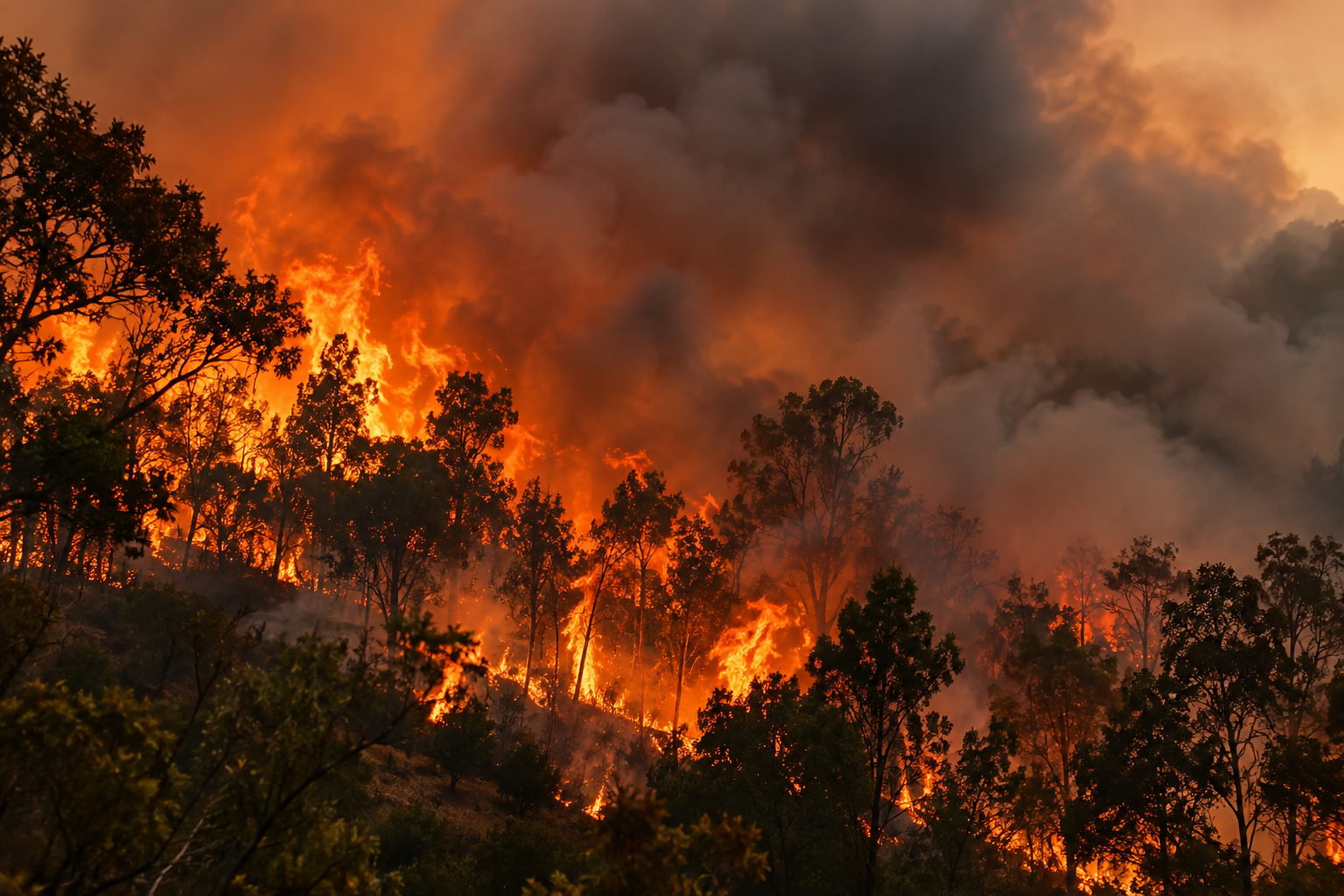
For Southern California employers, wildfire smoke is no longer an occasional disruption but a recurring seasonal reality, and California has a specific regulation governing what employers must do to protect workers when smoke rolls in.
Cal/OSHA’s wildfire smoke standard imposes concrete obligations that activate at a defined air quality threshold, and many employers are unaware of them until an inspection or an incident brings them into focus. The rule also contains specific exemptions that matter for understanding whether and how it applies to your operation.
At Health Science Associates, we help Southern California employers meet their wildfire smoke obligations, and here is what the rule requires when the AQI hits 151, and who is exempt.
The Threshold That Triggers the Rule
The wildfire smoke standard, found in California Code of Regulations Title 8 Section 5141.1, takes effect when the current Air Quality Index for airborne fine particulate matter, PM2.5, reaches 151 or higher, the level the AQI designates as Unhealthy, and when the employer could reasonably anticipate that employees may be exposed to wildfire smoke.
That AQI of 151 is the number every affected employer should know, because it is the point at which the rule’s requirements become active.
According to Cal/OSHA, the obligations under this standard begin when those conditions are met, which during a significant smoke event can happen quickly and across a wide area, including places far from the fire itself.
The Core Requirements at AQI 151
When the threshold is reached, covered employers must take several specific actions.
They must identify harmful exposure by checking the AQI for PM2.5 before each shift and periodically throughout the shift, so they know when the rule is triggered and when conditions change.
They must communicate to employees when the AQI reaches the harmful level, informing them of the conditions and the protective measures available, and they must maintain a system that allows employees to report worsening air quality or symptoms without fear of reprisal.
They must provide effective training to employees covering the health effects of wildfire smoke, the right to obtain medical treatment, and how the employer’s protective measures work.
Building that training and the written program behind it is core work for our environmental health and safety training courses.
Most significantly, employers must reduce harmful exposure where feasible through engineering and administrative controls, such as relocating work to enclosed buildings with filtered air or adjusting schedules, and when those controls cannot reduce exposure below the harmful threshold, they must provide proper respirators for voluntary use.
At AQI 151, respirator use is voluntary and employers must supply NIOSH-approved respirators such as N95s along with the required information for voluntary use. At much higher levels, above an AQI of 500 for PM2.5, respirator use becomes mandatory and the full respiratory protection program applies.
Who Is Covered
The standard applies broadly to workplaces where employees are exposed to wildfire smoke, which in practice means outdoor workplaces and indoor workplaces that do not effectively keep smoke out. Construction, landscaping, agriculture, delivery, warehousing with open bays, utility work, and outdoor operations of all kinds are squarely covered.
Indoor operations are covered when the building does not filter outdoor air effectively or when doors and windows are kept open, which means a warehouse operating with its bay doors open is treated much like an outdoor workplace for the purposes of the rule.
Who Is Exempt
The rule contains specific exemptions that are important to understand correctly. Enclosed buildings or structures in which the air is filtered by a mechanical ventilation system and the employer keeps windows, doors, and other openings closed to minimize smoke entry are exempt, because in that situation the smoke is being kept out and workers are protected.
Enclosed vehicles with functioning air conditioning set to recirculate, and with windows and openings kept closed, are similarly exempt for the same reason.
There is also an exemption for workplaces where employee exposure to the harmful PM2.5 level is expected to be brief, defined as a total of one hour or less during a shift.
These exemptions reflect the rule’s underlying logic: the obligations exist where workers are actually exposed to harmful smoke, and where effective protection already keeps exposure low or absent, the full requirements do not apply.
Determining whether your indoor spaces genuinely meet the filtered-air exemption, rather than assuming they do, is exactly the kind of question our certified industrial hygiene team evaluates.
Why Preparation Has to Happen in Advance
The defining challenge of this rule is that it activates suddenly. When a smoke event pushes the AQI past 151, an employer who has not already trained employees, established AQI monitoring, and stocked respirators is out of compliance immediately, with no time to catch up while the event is underway.
Because respirator supply tightens across the region the moment smoke arrives, advance stocking is essential rather than optional.
Get Ready Before the Next Smoke Event
The time to build your wildfire smoke compliance program is before the AQI climbs, not during a smoke event when it is too late to prepare.
If you are unsure whether the rule applies to your operation, which exemptions you can rely on, or whether your program meets the requirements, contact Health Science Associates to get your wildfire smoke compliance in order ahead of the next event.